

All hail the blue bomber. For those of us who grew up in the 80s, Megaman was an important pillar in our gaming experience. Offering tight and punishing gameplay, it set itself apart from the Mario Bros. and Alex Kidd games of the time. The Megaman series was probably my favourite platformer from that era, so it’s only fair to warn you that I and writing this review with no small amount of nostalgic bias. Featuring reproductions of the original 6 NES games alongside a historical repository, and all new challenge mode, Megaman Legacy Collection was toted as the ultimate Megaman experience for collectors and newcomers alike. So how did it hold up?
Let’s start with the original six titles. Unsure of what to expect I fired up the first game, and was immediately transported back to the lounge room floor of my youth! The nostalgic kick was strong and hit home as soon as the glorious 8-bit OST began. It wasn’t long before joy turned into frustration, as I remembered how punishing and uneven the Megaman games could be. The focus on precise timing, punishing hazards, quick deaths, and lack of checkpoints were a harsh reminder about what video games used to be like. That said the games weren’t entirely unfair – enemies and bosses all followed a pattern – you just had to learn the timing then ensure you didn’t mess it up! This proved surprisingly rewarding and it wasn’t long before my play style had adjusted to accommodate the game’s requirements.

If you’re new to the Megaman series this may seem a little daunting. The games all share a common theme based around tough, side-scrolling platformers that use a “learn by dying” means of progression. Initially restricted to firing just your Mega Blaster (an arm cannon) you must battle robot enemies through themed levels, each of which results in a unique fight against a robot master. These boss fights have long been a Megaman calling card and something that, to this day, remains distinct to the series. After defeating each robot master Megaman gains that boss’s special ability which he may then use against future bosses. The trick with the Megaman games is that each boss is particularly susceptible to one special ability. Having trouble beating Magnet Man? Maybe you should try using that Spark Shock you got from defeating Spark Man first. What’s that? You couldn’t beat Spark Man? Well he’s susceptible to Shadow Blades so I guess you’d better tackle that level before trying these. This brings us to another hallmark of the Mega Man series, which is the ability for players to select the order in which they tackle levels.
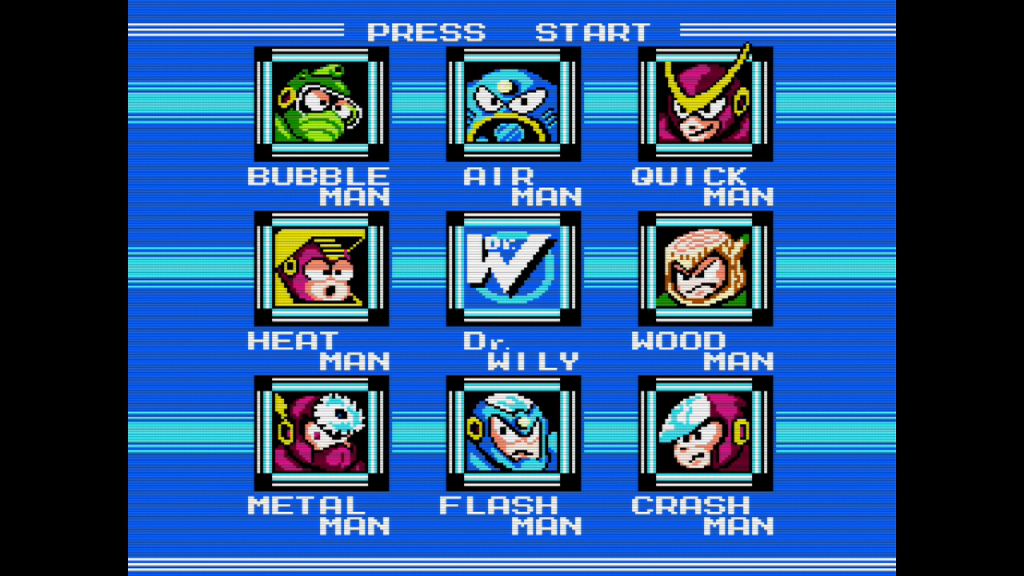
I’ll not delve further into what made the original games great. There are a plethora of reviews that explore them in detail, and I assume, if you’re considering buying this collection, you’re either a fan of the series looking to relive a classic experience, or a newcomer keen to learn where it all began. Earlier I mentioned that I was unsure of what to expect when I started these games. The Megaman Legacy Collection promoted “faithful reproductions of the series’ origins” but wasn’t specific on the methods they’d employ. Were games be cleaned up versions of the originals? Or perhaps remade versions with replicated mechanics and modern aids? As much as I loved the original series I’m also a fan of games receiving graphical overhauls, so I wouldn’t have been adverse to a nicely 3D rendered overlay – maybe with the option to flick between that and the original. As it happens the games feel like direct ports from the NES classics. This, in itself, isn’t a bad thing however it does mean all the faults of the original have translated across as well. The game slows noticeably when many shots are fired, or when too many enemies are on screen at a time. In later games, like Megaman 6, there’s even a noticeable line on the right hand side as the next part of the level is drawn.
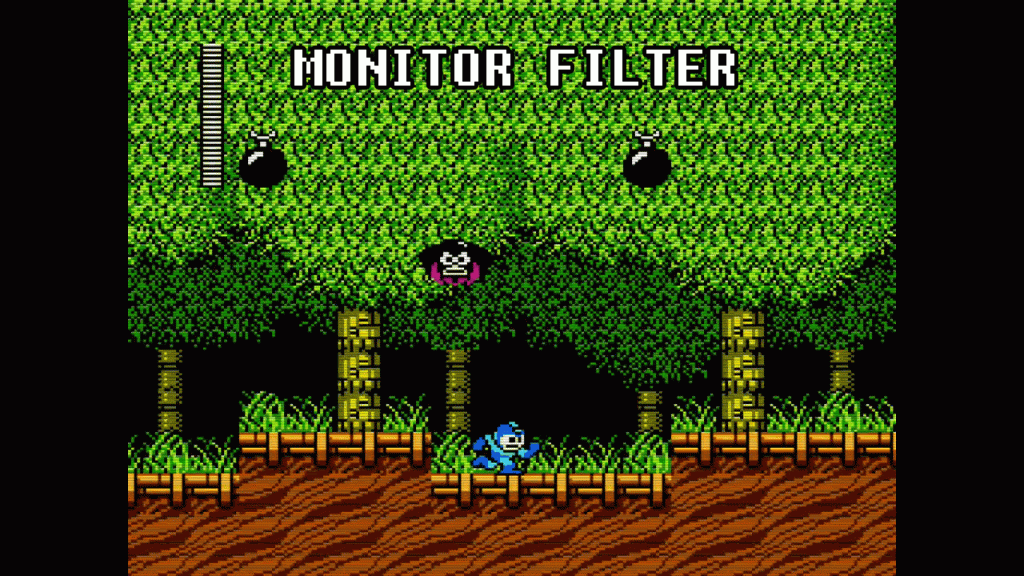
On the plus side you do get some advantages similar those you’d experience were you to play the games on an emulator. You can save and load at any time and can even use rapid fire buttons to emulate mashing the fire button at ludicrous speed. These features do feel a little “cheaty” however, and can dampen the challenge. Alongside this there are a few aesthetic tweaks that are interesting to play with. You can adjust screen size between original, zoomed or stretched (although why you’d want to stretch 4:6 to 16:9 is beyond me!). You can also add filters and/or a contextual background image to replace the black letterbox bars. The monitor filter is interesting, adding horizontal lines between pixels to give a more textured feel, while the TV filter adds blur (which just feels strange). None of these features affect gameplay though, and feel more like a minor add-ons. I appreciate their presence but feel there was a missed opportunity to have some real fun with graphical enhancement.
Alongside the reproductions of the original six games the Megaman Legacy Collection offers two additional modes; Museum mode and Challenge mode. Museum mode is basically just an in-game repository of art covering production art, character files, concept art and promo material. Accompanying this is a database section offering statistics and tactics for most in-game enemies (although very few bosses which was a shame)
Challenge mode is, in my opinion, what makes the Megaman Legacy Collection really worth considering. Combining remixes of levels from all six games with timed boss fights, special challenges, and scaling difficulty, challenge mode offers a shorter, more competitive game experience unique to this collection. Challenges must be completed in the fastest time possible and, upon completion, players can see how they rank on global leaderboards. Furthermore you are able to watch replays of how others achieved their top scores giving you useful hints and tips on how you can try for that top spot.
All in all the Megaman Legacy Collection is an enjoyable collection. It feels a little “cheap” in its implementation however it comes at a very low cost. $30 AUD for 6 remade NES classics plus a new challenge mode and some nostalgic artwork is a pretty decent deal. If you’re new to the series be warned; Megaman is a fantastic platformer but brutal and challenging. It was one of the forerunners in platformer design and doesn’t have the gameplay assists of current 8-bit themed titles like Shovel Knight. That said the “cheats” I mentioned earlier make it considerably easier to complete giving you a great way to see the games whilst minimising the frustration. If you’re an established fan of the series the Megaman Legacy Collection is a great way to centralise your collection. The ease of play and challenge levels alone are worth your time and re-investment in this classic collection.