

Life can be difficult, unfair, and depressing at times. Some believe these moments help us properly appreciate the good however, in Gloom, they serve the greater purpose of providing the backdrop for a fantastic story! Played with unique, clear cards Gloom combines solid gameplay with great social aspects totranscend the gimmick and provide an original and enjoyable experience.
Your goal, in Gloom, is to make your family suffer as many tragedies as possible before falling victim to untimely death. At the start of the game players select a family of misfits and places them, face up, in the communal playing area. These cards are double sided with on side displaying the character’s name and back-story while the other shows their tombstone. The character cards offer no specific gameplay benefit but their descriptions provide a good baseline for their tale of woeful misadventure. There are four families in the standard game, each with their own amusing theme, however you’re not restricted to using the starting configurations and can mix and match your family as desired.
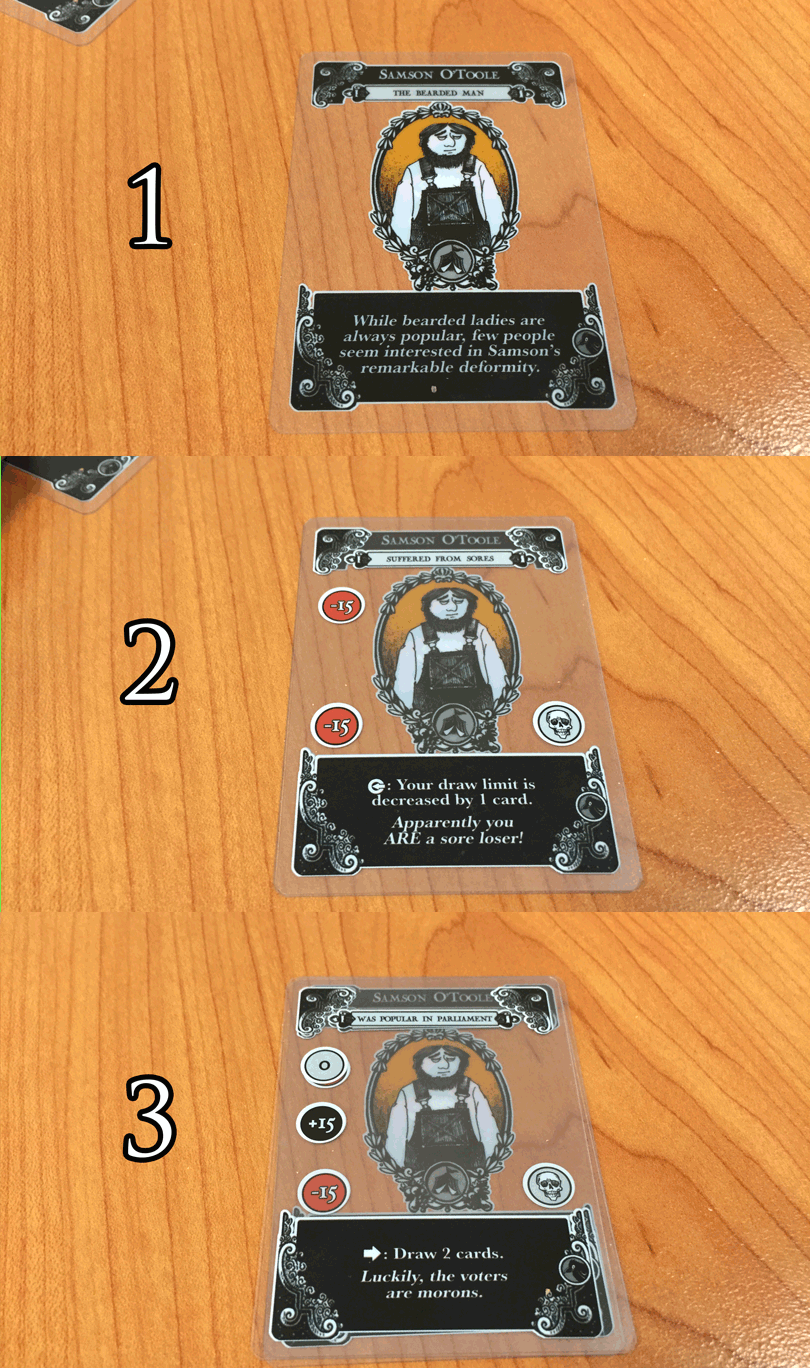
Gloom can be played as “just a card game” however it’s best enjoyed with a healthy dose of creative storytelling. The way your story unfolds is by players creatively describing the events on cards they play. Players each start with a hand of five cards comprised of a random mixture of modifier, event and untimely death cards. Each turn players may play two of their cards and resolve the effects. Modifier cards are the most common and may be played on any living character (either yours or an opponents). On the left side of the card are three positions for scores – nice occasions like “having a wonderful picnic” will have positive values whilst detrimental ones like “broke all her bones” carry a negative score. In Gloom your characters score is calculated as the sum of all visible numbers and the lower your score – the better it is. The cards are mostly transparent so playing one card on top of another can cancel out certain effects – making for a tense game where timely card choice is key.
For example; in the below image Samson O’Toole, the bearded man, is grievously hurt by the fact that people don’t find bearded men as entertaining as bearded ladies. Suffering from sore loser syndrome he receives two -15 score multipliers (shown on the left left side of the card) changing Samson’s current score to -30. This is a good score because, let’s not forget, all the best stories are tragic. However, on the next players turn, they decide that his stately beard gives him a “presidential” appearance making him very popular in parliament. That person plays a positive modifier on the current pile replacing the top value with 0 and introducing a middle value of +15. When you calculate Samson’s score you can see it now totals 0 meaning that player 2 has effectively voided the modifiers from player 1’s card.
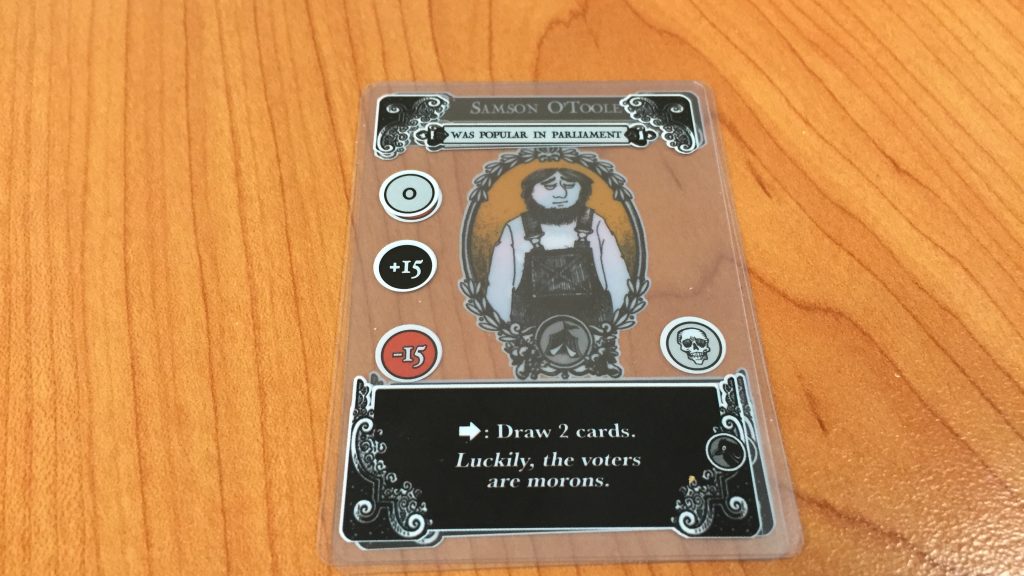
In addition to changing the score modifier cards also have effects. These are described on the lower half of the card and affect the person who’s family the card is played agianst. In the above example, the first card forces the player to be able to hold fewer cards in their hand whereas the second lets them immediately draw two additional. The combination of effects and score modifiers can make for interesting strategy as you must weigh the benefits against the disadvantages when decided where to play a card. For example; you may wish to play a positive modifier on yourself to take advantage of the effect knowing you can cancel out the negative score later.
Not all cards are played on family members however. Gloom also features event cards – single use cards you discard after use. Their effects are typically more powerful than modifiers however, as they don’t directly affect the score, they can be easier to plan. Effects on both modifier and event cards vary depending on type and can persistent or instantaneous. Sometimes they take effect immediately, other times they are played out of turn in response to another player. Quite often modifier card effects persist until covered by another card. The variety and balance in these effects is well implemented and ensures an enjoyable yet often unpredictable game every time.
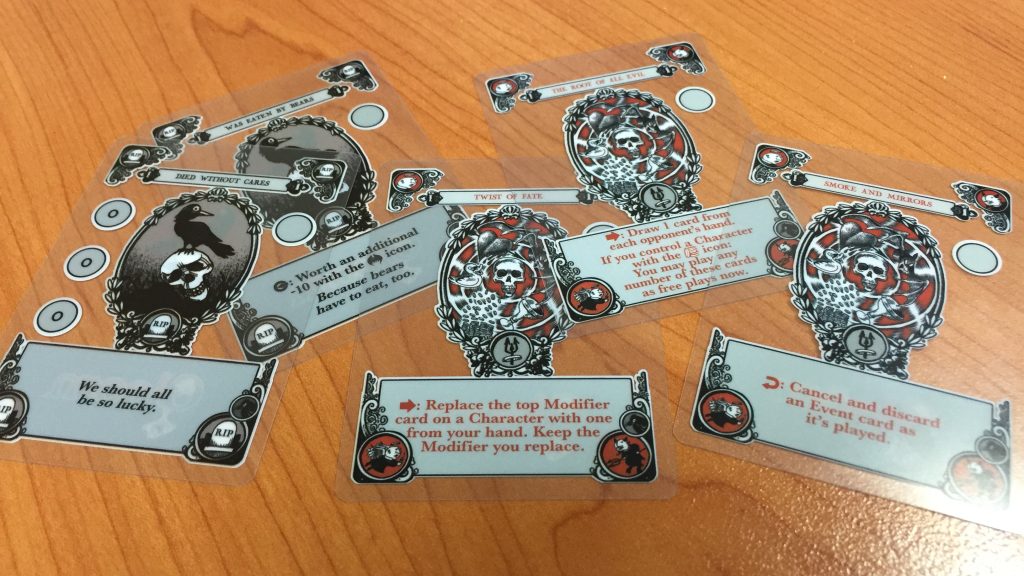
The final card type (pun totally intended) comes in the form of the untimely death cards. Only playable on characters with a negative score they effectively “kill off” a character meaning you are unable to play any more cards on that person. The game ends when all of one family’s members are dead and the winner is deemed the person with the lowest score. There’s an important catch though – only dead family members may count towards your score. This is an important distinction to make as it can greatly affect your strategy. Do you hold off and try for greater misfortune or get in quick and kill off your family before the others have a chance thus increasing your chance of the best score?
While the game’s mechanics are great and the strategic element sound, Gloom really starts to shine when players get involved with their family’s story. Every card comes with an amusing description however things really become interesting when you start relating events together. For example; using the below cards we can see that Professor Helena Slogar, who enjoys gardening and long walks in the moonlight, commenced her story with a delightful picnic in the park. Unfortunately her penchant for reanimating the dead seemed to disturb the other citizens and she was jailed as a result. Kicked out of the prison dance for her crabcore tastes the warden took pity on her – a mutual affection grew and they were magnificently married. Not the type to let a grudge slide the inmates, guards and park goers gathered up torches and pitchforks, formed a mob, and burnt poor Helena at the stake. The warden remains faithful but finds her ashes make for poor conversation.
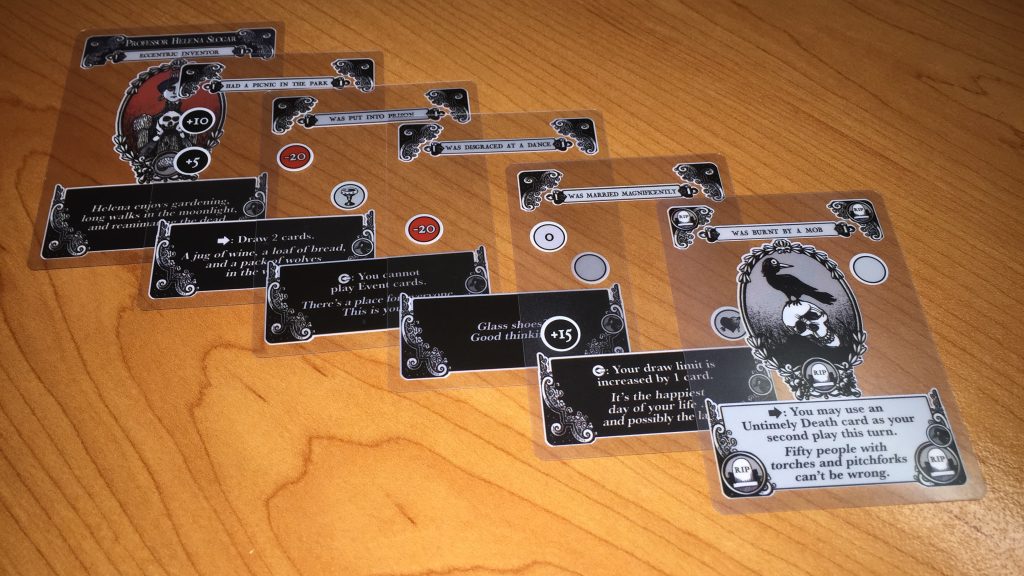
If you’re lucky enough to play with a creative group the stories can evolve even further to create one over-arching tale of woe and misfortune. The cards provide the core game and amusing ideas but it’s the players who piece them together to form an enjoyable tale.
For a game that relies so strongly on a unique mechanic it would be easy to dismiss Gloom as “just a game with a gimmick”. To do so would be an error however, as the gameplay is solid, the mechanics well utilised and the experience extremely enjoyable. If you have a group of friends who enjoy telling a good story then this is a game you should play! Not since Monty Python’s Four Yorkshire men sketch has telling a tale of woe been so much fun!